
Device-LevelSignal Identification
Emitter Fingerprinting Technology
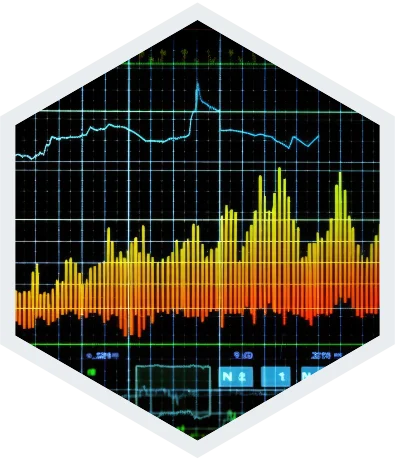
Emitter fingerprinting analyzes subtle characteristics within RF signals to uniquely identify the individual device that transmitted them.
 Modern electromagnetic environments are congested, contested, and increasingly deceptive. Accurately identifying the source of a signal is critical for maintaining situational awareness and making confident operational decisions. Emitter fingerprinting analyzes hardware-induced signal characteristics such as oscillator drift, gain mismatch, and out-of-band emissions to distinguish individual transmitters. By transforming these unique signal features into identifiable signatures, operators gain the ability to track specific emitters, verify signal authenticity, and better understand the electromagnetic battlespace.
Emitter
Emitter fingerprinting is an analytical approach that identifies unique characteristics introduced by physical hardware imperfections within transmitting devices. Small variations in components such as oscillators, amplifiers, and signal chains create subtle but measurable differences in transmitted signals. These characteristics form identifiable patterns that can be analyzed and associated with a specific emitter.
Precise Systems combines advanced signal analysis and machine learning to detect and classify these characteristics. The Y-STN workflow supports the development and training of models that recognize these patterns, while the INT-PAS platform deploys those models at the operational edge to perform real-time identification within deployed systems.
Mission Applications
Emitter fingerprinting enables a range of advanced signal intelligence capabilities by distinguishing individual sources within complex RF environments. These capabilities are critical to military operations, supporting identification, tracking, and decision-making in congested and contested spectrum conditions.
Device-Level Identification
Emitter fingerprinting enables identification of specific transmitting devices rather than simply classifying signal types.
Anti-Fratricide
Distinguishing friendly systems from adversary emitters within congested RF environments reduces the risk of interference or unintended disruption of friendly communications.
Battlespace Awareness
Tracking individual emitters strengthens electromagnetic order of battle awareness by identifying and monitoring multiple transmitters of the same class operating within the environment.
Multiple Threat Disambiguation
Separating multiple emitters with similar signal characteristics improves situational awareness and enables more informed operational responses.
Cognitive EW Enablement
Real-time identification of emitters supports automated decision processes within cognitive electromagnetic warfare systems deployed at the edge.
Counter-Spoofing
Emitter fingerprinting enables verification of signal origin, helping detect manipulated transmissions and spoofing attempts generated through adversary RF deception techniques.

Enabling Technologies
Delivering emitter fingerprinting requires an integrated approach that supports both capability development and operational deployment. Advanced signal analysis must be paired with environments for feature discovery, model training, and refinement, along with platforms that execute those models in real time. Together, these technologies ensure a seamless transition from development to application, enabling reliable signal identification and sustained performance in complex electromagnetic environments.
-

Y-STN
A complete RF data annotation, spectrum analysis, and machine learning training workflow fully aligned with the SigMF standard. Y-STN provides the environment for developing, training, and refining models that identify signal characteristics and support advanced RF analysis.
Learn More About Y-STN -

INT-PAS
A modular edge-deployment platform designed to host and execute AI models within operational systems. INT-PAS integrates with a proprietary inference engine to enable real-time signal analysis directly at the edge, supporting responsive and resilient electromagnetic operations.
Learn More About INT-PAS